
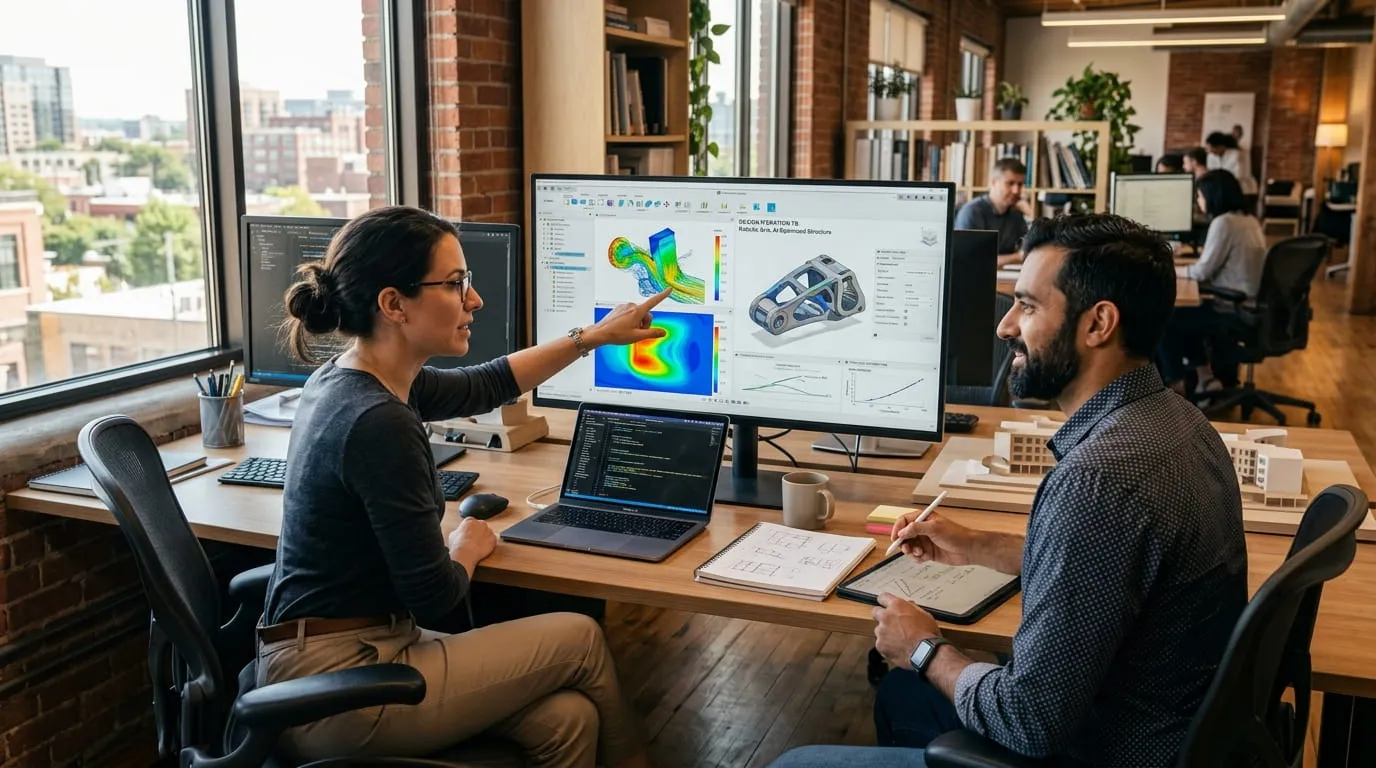
No. AI is not on track to replace engineers as a profession. It is replacing specific tasks inside engineering work, which is a very different thing. Drafting code, running standard simulations, checking documentation for errors, and generating early design options are increasingly handled by AI tools. Defining the actual problem, setting the constraints that matter, weighing tradeoffs between cost and safety, and taking responsibility for a design decision still require a person.
That distinction between “task” and “job” is where most of the confusion in this conversation comes from, so it’s worth breaking down carefully.
What AI Actually Does In Engineering Right Now
Most engineering teams already use AI somewhere in their workflow, even if the tool itself doesn’t market itself with that label. The applications cluster into three areas.
1: Design And Simulation
Generative design tools can produce hundreds of structural or component variants that meet a given load, weight, or cost target, in far less time than a human could model them manually. Simulation software increasingly uses trained surrogate models to approximate results that would otherwise take hours of physics-based computation. This speeds up early-stage iteration significantly. It does not remove the need for an engineer to decide which of those variants is actually manufacturable, or which one holds up under a load case the model wasn’t trained on.
2: Documentation And Repetitive Analysis
AI handles a large share of routine paperwork now: formatting technical specs, checking calculations against known standards, flagging inconsistencies between drawings and bills of materials. This is genuinely useful, and it’s also the least controversial use of AI in engineering, because almost nobody misses doing this work by hand.
3: Predictive Maintenance And Monitoring
In manufacturing and infrastructure settings, AI models trained on sensor data can flag equipment likely to fail before it does. This shifts maintenance from a fixed schedule to a condition-based one, which saves money and downtime. The engineer’s role moves toward interpreting flagged anomalies and deciding what action to take, rather than manually inspecting every unit on a rotation.
Why Full Replacement Is Unlikely
Engineering work depends on judgment calls that don’t have a single correct answer pulled from a dataset. A structural engineer deciding how much safety margin to build into a bridge design is weighing regulatory requirements, site-specific conditions, budget, and long-term maintenance access, often simultaneously. AI models are trained on historical data and patterns. They struggle with genuinely novel configurations that fall outside that training distribution, which is precisely where a lot of real engineering problems live.
There’s also accountability. When a design fails, someone has to be legally and professionally responsible for the decisions that led to it. Licensed engineers sign off on work with their professional judgment attached to it. That responsibility doesn’t transfer to a model, no matter how capable the model’s output looks.
None of this means AI’s role stays small. It means the role stays bounded to well-defined, data-rich tasks, while the parts of the job requiring context and accountability stay with people.
How The Risk Differs By Engineering Discipline
Not every engineering field faces the same exposure to AI-driven task automation. The differences come down to how standardized the work is and how much of it depends on physical, site-specific, or safety-critical judgment.
1: Software Engineers
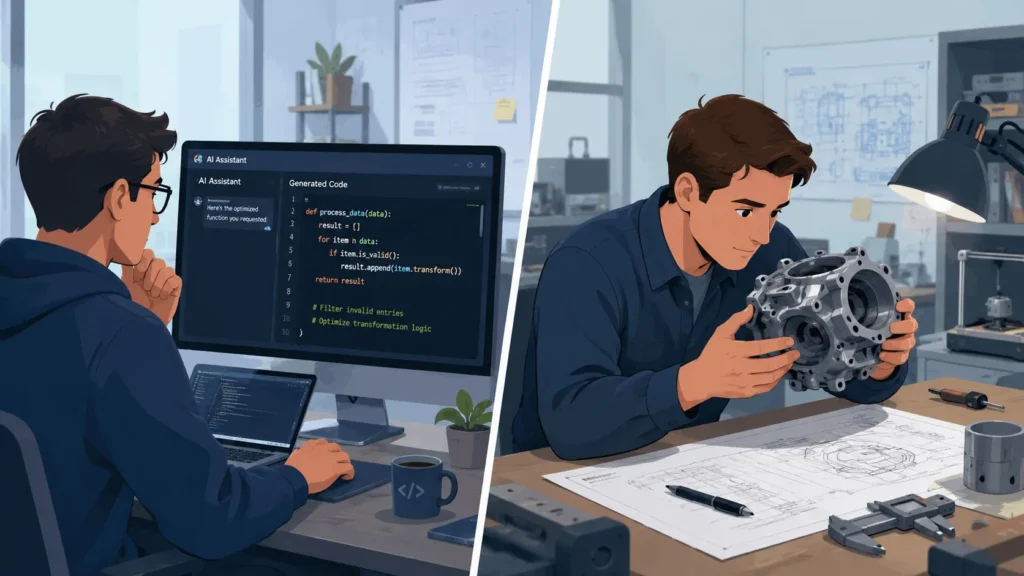
This field sees the most day-to-day AI involvement already. Code-completion and code-generation tools can produce working boilerplate, write tests, and even suggest architecture patterns. Junior-level tasks like writing repetitive CRUD functions are the most automatable. Senior work like system design, debugging subtle production issues, and making architectural tradeoffs under real constraints stays firmly human, at least for now.
2: Mechanical And Structural Engineers
Generative design and simulation speedups are reshaping the early design phase. Physical prototyping, tolerance stacking, and manufacturability checks still require hands-on expertise that AI can support but not fully replace. A model can suggest a lighter bracket geometry, but someone still has to confirm it can actually be machined or molded at the tolerances the shop can hit.
3: Electrical And Civil Engineers
These fields are more constrained by physical infrastructure, local codes, and site conditions than by pure computation, so AI adoption has been slower and more targeted. Circuit layout tools and structural analysis software use AI to speed up specific calculations, but permitting, site inspection, and code compliance remain judgment-heavy and locally variable.
4: Data And Systems Engineers
Ironically, the engineers who build and maintain AI systems face some of the lowest replacement risk, because the field keeps expanding rather than automating itself away. Demand for people who can design data pipelines, tune models, and manage system-level integration has grown alongside AI adoption, not shrunk.
What AI Cannot Do Yet
A few capabilities remain firmly out of reach for current AI systems, and they happen to be central to what makes someone a good engineer rather than just a fast one.
Framing an ambiguous problem correctly. Clients and stakeholders rarely describe what they need with technical precision. Translating a vague business goal into a well-defined engineering problem is a skill AI cannot replicate, because the model needs the problem already framed before it can help.
Weighing tradeoffs with incomplete information. Real projects run into budget cuts, supply shortages, and schedule pressure mid-way through. Deciding which corner is safe to cut and which one isn’t requires context an AI model doesn’t have access to.
Taking accountability for a decision. Professional engineering licenses exist because someone has to be answerable for public safety. That responsibility can’t be automated away, regardless of how good the underlying tool becomes.
Working across disciplines under uncertainty. Coordinating between mechanical, electrical, and software teams on a single product, where each change ripples into the others, still depends on human communication and negotiation.
New Roles AI Is Creating
Adoption of AI tools inside engineering teams is also creating entirely new job categories rather than only shrinking old ones. AI-assisted design specialists work alongside generative design tools to validate and refine model outputs. Simulation engineers focused on training and maintaining surrogate models are becoming a distinct specialty within larger engineering organizations. Robotics integration engineers connect AI-driven perception and control systems to physical hardware on the factory floor.
These roles didn’t exist in their current form a decade ago. They point toward where the field is actually heading: more specialization around AI tools, not fewer people needed overall.
How To Future-Proof Your Engineering Career
The engineers most exposed to AI-driven disruption are the ones whose day-to-day work is the most repetitive and the least dependent on context. A few practical moves reduce that exposure.
Learn to work with AI tools directly instead of avoiding them. Fluency with generative design software, AI-assisted coding tools, or simulation surrogates is becoming a baseline expectation, not a specialty.
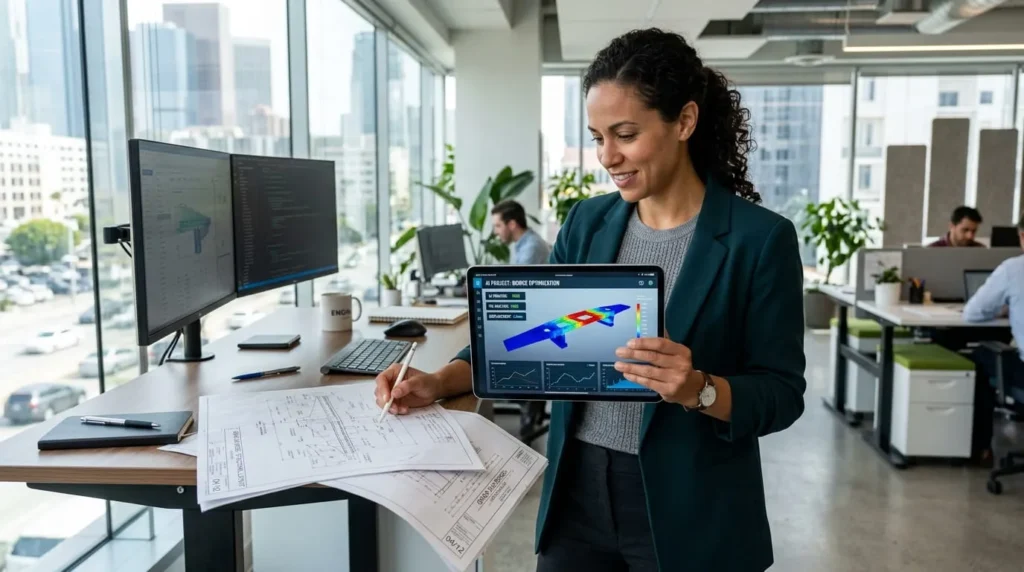
Build depth in judgment-heavy areas. Systems-level thinking, cross-disciplinary coordination, and problem framing are hard to automate and increasingly valuable as routine tasks get faster.
Develop data literacy. Even outside data-focused roles, understanding how the AI tools in your workflow were trained and where they’re likely to fail makes you better at catching their mistakes.
Stay close to physical and regulatory realities. Manufacturability, code compliance, and site conditions are exactly the areas where AI models have the least reliable data to draw from.
What This Means Over The Next Five To Ten Years
Expect the tools embedded in everyday engineering software to get noticeably better at handling well-defined, data-rich tasks. Simulation will get faster. Documentation will get more automated. Early-stage design exploration will involve less manual iteration. None of that adds up to engineers becoming unnecessary.

What changes is the shape of the job. Less time on repetitive calculation and formatting, more time on framing problems, validating AI output, and making the calls that require context a model doesn’t have. Engineers who treat AI as a tool that extends their judgment, rather than a threat to avoid, are the ones positioned best for where the field is heading.