

If you’re searching for jobs safe from AI, the honest answer is more useful than a simple list. No occupation is fully immune. What actually protects a job is a specific mix of tasks inside it: physical presence, high-stakes judgment, accountability, and relationships built over time. Roles that lean on those four things are holding up well. Roles built from repeatable, rules-based tasks are shrinking fast, even inside professions that look secure on paper.
This matters because the risk sits at the task level, not the job title level. A lawyer and a paralegal share a job family, but their day-to-day work exposes them to very different levels of automation. The same split shows up in healthcare, banking, and hospitality. Understanding that split is more useful than memorizing a list of “safe” titles, because titles change and task mixes change faster.
Why “AI-Proof” Is the Wrong Way to Frame Job Safety
Researchers who study labor markets and language models have generally moved away from ranking whole occupations as safe or unsafe. Instead, they break each job into its component tasks and score how exposed each task is to current AI capability. A single job can contain a mix of highly exposed tasks and barely exposed ones.
Take a financial analyst. Pulling data and building a first-draft summary is now something AI handles quickly. Deciding what that summary means for a client’s risk tolerance, and standing behind that call, is not. The job survives because the second task still needs a person, even though the first one no longer does.
This is also why entry-level roles feel more precarious than senior ones in the same field. Junior employees historically learned the trade by doing the repetitive tasks that AI now absorbs first: document review, basic drafting, data entry, scheduling. The training ground is shrinking before the profession itself does.
The Pattern Behind Every Job That Resists Automation
Across healthcare, law, construction, education, and finance, the same four qualities keep showing up in the roles that are holding steady.
1: Judgment Under Uncertainty
AI can summarize a case file, flag anomalies, or draft a treatment plan. It cannot weigh incomplete, contradictory information and commit to a decision it will be held responsible for. A surgeon deciding whether to operate, a judge weighing sentencing, or a compliance officer flagging a transaction all rely on judgment formed from years of pattern recognition that goes beyond what a model can access.
2: Physical Presence in Variable Environments
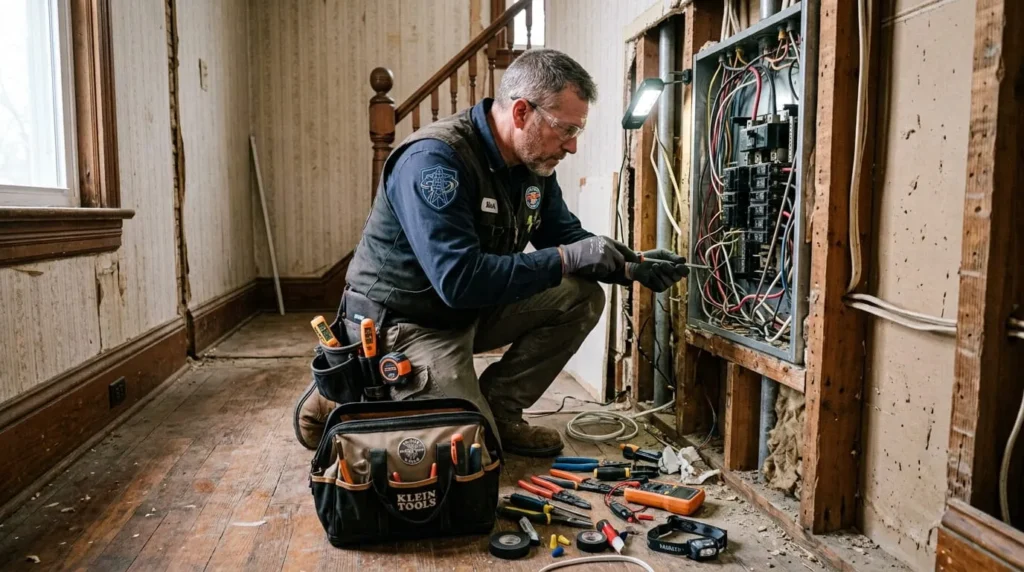
Skilled trades stay resistant because no two job sites look the same. An electrician rewiring a hundred-year-old house, a plumber fixing a flooded basement at 2 a.m., or a nurse repositioning a patient all work in physical spaces that change constantly. Robotics is improving, but general-purpose physical dexterity in unpredictable settings remains far behind language capability.
3: Relationship and Trust Built Over Time
A patient trusts their longtime doctor’s judgment partly because of the relationship, not only the diagnosis. A family chooses a lawyer they’ve used for years over a cheaper unknown option. This kind of trust compounds slowly and cannot be transferred to a new tool overnight, which insulates roles built around it.
4: Accountability for the Outcome
Someone has to be legally and professionally responsible when a decision goes wrong. AI can generate a recommendation, but it cannot be sued, licensed, fired, or held liable. Every profession that requires a license, from nursing to structural engineering, keeps a human in the final decision seat for this reason alone.
Jobs Safe From AI Right Now, by Field
1: Healthcare
Administrative healthcare roles, like medical secretaries and prescription processing staff, face real pressure because their work follows set forms and routine queries. Clinical roles are a different story. Doctors, nurses, and pharmacists carry legal responsibility for patient safety, and AI cannot absorb that responsibility even when it improves diagnostic accuracy. Exposure still varies by specialty. Radiology faces meaningful change because AI reads scans with high accuracy, while highly individualized specialties like plastic surgery see far less disruption.
2: Skilled Trades
Bricklaying, carpentry, plastering, electrical work, and plumbing continue to offer strong long-term prospects, particularly at small local firms where every job differs from the last. Large infrastructure projects may eventually see more automation, but that shift remains distant for most tradespeople.
3: Education and Childcare
Teaching holds up because students need a trusted adult relationship to learn effectively, not just accurate information delivery. The same logic protects childcare. Parents want a human being caring for their children, and that preference is not primarily about information accuracy at all.
4: Legal Judgment Roles
Litigation, family law, and any legal work involving direct client judgment remain comparatively secure. Document review, first-draft contract generation, and routine form completion are shifting fast, which is exactly why junior lawyers are being pushed toward client-facing judgment work earlier in their careers than before.
5: Hospitality’s Relationship-Driven Roles
Front-of-house hospitality workers who create genuine warmth and connection, along with chefs producing original, high-end cuisine, remain difficult to automate. AI is absorbing the routine parts of hospitality, like correspondence and booking logistics, which frees staff to spend more time on the guest interactions that actually build loyalty.
Jobs Facing the Most Disruption
To fully answer what jobs are safe from AI, it helps to name what isn’t. Administrative assistants, data-entry staff, office clerks, and prescription processors are seeing task volume shrink quickly, even where headcount hasn’t dropped yet. Junior analysts, some marketing functions, and entry-level content production face similar pressure because their output is structured and predictable, which is exactly what current AI systems handle well. Bank call centers, middle-office operations, and branch roles built around repetitive customer interaction show the same pattern.
None of this means these jobs vanish overnight. It means the routine share of the work keeps shrinking, and the people who stay employed in these fields are usually the ones who shift toward judgment, oversight, and client interaction rather than pure task execution.
How to Make Your Own Job More AI Resistant
You do not need to abandon your field to build more security into your role. Career strategists who study this shift consistently point to the same move: reposition toward the parts of your job AI cannot do, rather than starting over completely.

An administrative assistant who leans into project coordination and stakeholder communication becomes harder to replace than one focused purely on scheduling. A bookkeeper who develops financial analysis skills shifts from data entry into interpretation. A content writer who builds strategic messaging skills moves past pure production into judgment work. In each case, the underlying domain knowledge carries over. What changes is which tasks you spend your time on.
Learning to direct AI tools rather than compete with them adds a second layer of protection. Someone who can evaluate AI output, catch its errors, and refine its results is functioning as a quality check the system cannot provide for itself.
Common Questions About Job Safety and AI
1: Will My Job Be Fully Automated Within a Few Years?
Full automation of an entire role is rare. What happens more often is partial automation, where the routine share of your tasks shrinks and the remaining work concentrates around judgment, oversight, and relationships. Watch how much of your week is spent on predictable, repeatable tasks versus decisions that require context only you have.
2: Should I Switch Careers Now?
Not necessarily. A pivot into a new industry that involves the same predictable, repeatable task mix offers little real protection. It is usually more effective to shift the type of work you do within your current field, moving toward judgment and client-facing responsibility, before considering a full career change.
3: What Skills Actually Matter Right Now?
Communication, situational judgment, and the ability to evaluate AI output for accuracy and appropriateness matter more than any single software skill. Technical AI literacy helps, but it works best layered on top of domain expertise you already have, not as a replacement for it.