

Ask which platform excels in AI visibility metrics and the answer changes depending on which metric you care about. A tool that leads on citation-level detail often ranks near the bottom on engine breadth. A platform with the cleanest share of voice math might skip sentiment scoring entirely. I compared the current field of AI visibility tools side by side. The honest answer: no single platform wins every metric available. The right pick depends on which numbers your team needs to act on this quarter.
This guide breaks down the metrics that actually matter. It shows which platforms handle each one best. And it explains where the differences change what you can do with the data.
What Counts as an AI Visibility Metric
An AI visibility metric measures something specific about how a brand shows up inside AI-generated answers. It doesn’t measure how a website ranks in search results. Four metrics show up in nearly every platform: mention rate, share of voice, citation frequency, and sentiment. A fifth, engine and geographic coverage, decides how much of the full picture you actually see.
Mention rate answers a simple yes or no question: did the brand appear in an answer to a given prompt. Share of voice turns that into a percentage against named competitors, across a set of tracked prompts. Citation frequency counts how often a specific URL gets referenced as a source. This matters more than a mention, because it points to exactly what content the AI models trust. Sentiment adds a layer of judgment. It scores whether a mention reads as a genuine recommendation or a passing, neutral reference.
Not every platform tracks all five. Some tools stop at mention rate and share of voice. That’s a reasonable way to build a dashboard, but it leaves citation and sentiment data out entirely. Before comparing tools, decide which of the five metrics your team needs first.
Share of Voice: Where the Calculations Diverge
Share of voice sounds like a single number. But the math behind it varies by platform. That difference changes what the number actually means.
Some platforms calculate share of voice as the percentage of tracked prompts where a brand appears at all. They don’t account for position or tone. Others weight it by how prominently a brand is mentioned relative to competitors within the same answer. A smaller group separates positive citations from neutral or dismissive references first. That produces a more honest figure, though also a lower one.
Peec AI and SE Visible both publish a straightforward version. It’s the prompts where you appear, divided by total prompts tracked, shown next to a raw competitor comparison. Omnia pairs the percentage with the underlying prompt list. A marketing lead can click through and see exactly which prompts are driving or dragging the number. That transparency matters more than the percentage itself. A share of voice figure without a visible denominator is something a team can report. It isn’t something a team can act on.
Citation Tracking: The Metric With the Most Practical Value
Citation tracking answers a more useful question than mention rate. It shows which exact page an AI engine pulled from. Not just that the brand came up somewhere.
This is where platform differences become significant. Ahrefs Brand Radar pairs its citation index with existing backlink and organic ranking data. That lets a team see whether a page earning AI citations also ranks well in traditional search. Or whether the two are unrelated for that domain. Omnia and AthenaHQ push citation data further into diagnosis. They map cited pages by topic, so a team can see the exact content gap. That gap is what lets a competitor’s guide get referenced instead of theirs.

The trap is treating domain-level citation counts as equivalent to exact-URL counts. Knowing a competitor’s domain got cited forty times tells you less than knowing which page earned those citations. If a platform reports only at the domain level, check during a trial whether page-level detail is available. That gap changes how usable the tool actually is.
Engine and Geographic Coverage: More Isn’t Always Better
Three engines, ChatGPT, Perplexity, and Google AI Overviews or AI Mode, account for most AI search activity. That’s true for the average brand. Coverage beyond that point matters mainly for two groups. Enterprises with a global footprint are one. Brands selling into categories where a fourth engine, like Gemini or Copilot, genuinely shapes buying decisions are the other.
Profound and Brandlight lead on raw engine count. Both track ten or more platforms with enterprise-level detail. That breadth is valuable if a brand needs board-level reporting across every surface a competitor might use. For most mid-market teams, tracking four engines well beats tracking eleven engines shallowly. Daily refresh and full citation detail matter more than raw engine count.
Geographic and language coverage follows a similar pattern. A brand selling only in English-speaking markets gains little from a platform’s twelve-language support. A brand expanding into new regions should weigh country-level segmentation heavily. AI answers to the same query can differ sharply by country and language.
Sentiment Analysis: Reading the Tone, Not Just the Mention
A brand can appear in an AI answer and still lose the sale. That happens when it gets framed as the inferior option. Sentiment analysis is the metric built to catch that.
Sentiment scoring in this category is younger and less standardized than share of voice or citation tracking. Surfer’s Mention Gap and Sentiment Analysis feature, added to its AI Tracker, flags where a competitor gets framed more favorably. Peec AI and Omnia both fold sentiment into their per-prompt views. They don’t report it as a separate score. That keeps the number tied to a specific answer a person can actually read.
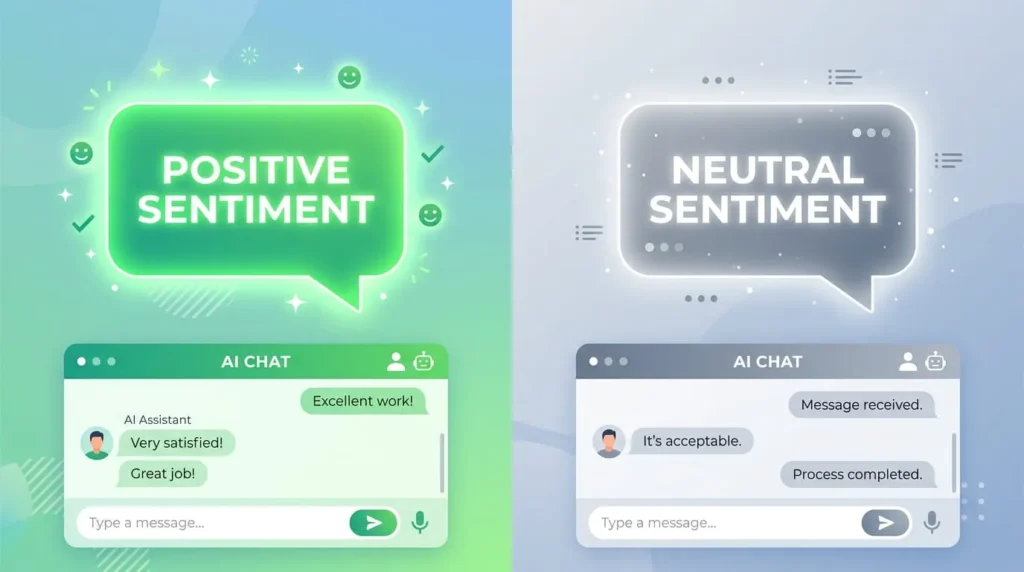
Treat any sentiment score as directional, not exact. Language models phrase the same underlying fact differently across runs. A sentiment classifier trained to detect tone will sometimes misread a hedge or a comparison as neutral or negative. The screenshot behind the score matters more than the score itself.
Monitoring Metrics vs Execution Metrics
A platform can excel at metric accuracy and still leave a team without a next step. That gap splits the category into two different jobs.
Pure monitoring platforms focus on getting the numbers right. Profound, Peec AI, Rankscale, and SE Visible fall into this group. They aim for clean share of voice math, reliable citation extraction, and consistent refresh cycles. They don’t publish content or close the gap they find. Monitoring-plus-action platforms add a layer on top. Omnia and AthenaHQ turn a citation gap into a specific content recommendation. A person still has to write and publish it.
A third category, programmatic content platforms, skips metrics rigor in favor of publishing volume. These tools often position monitoring-only platforms as insufficient on their own. That framing has some truth to it. A dashboard that shows a gap without a path to close it is only half useful. But the tradeoff runs both ways. Programmatic publishing at scale can produce citations faster. It also puts less emphasis on verifying which specific metric moved and why. That matters when a team reports results to a board or a client.
Neither model is universally better. A team building a quarterly report needs the monitoring layer to be accurate first. A team under pressure to show citation growth fast may value speed over methodology detail.
Matching a Platform to the Metric That Matters Most
1: If Board Reporting Is the Priority
Choose a platform with a visible, disclosed share of voice formula and exportable data. Omnia, SE Visible, and Semrush AI Visibility Toolkit all show their math rather than hiding it behind a black-box score.
2: If Citation Forensics Is the Priority
Choose Ahrefs Brand Radar for scale and cross-referencing with existing SEO data. Or choose Omnia and AthenaHQ for page-level diagnosis tied to content recommendations.
3: If Broad Engine Coverage Is the Priority
Choose Profound or Brandlight. Both track ten or more engines. Pricing rises quickly, though, and the entry tier often limits you to one engine or one seat.
4: If Budget Is the Deciding Metric
Start with a low-cost or free tier, such as LLMrefs or Geneo. Use it to confirm the category is worth investing in. Then upgrade to a plan with deeper citation and sentiment features.