

Private AI is any artificial intelligence system that runs inside an organization’s own infrastructure instead of on a shared, third-party server. The model, the data it uses, and the results it produces stay under the organization’s control from start to finish. Nothing gets sent to an outside company’s servers unless that company built the private environment specifically for you.
That single detail, where the data physically lives and who can see it, is what separates private AI from the public chatbots and APIs most people use every day. When you type a question into a general-purpose AI tool, your input often travels to a third-party server, gets processed there, and may be stored or reviewed to improve that provider’s models. Private AI removes that step. The model sits inside a company’s own data center, a private cloud, or a tightly controlled environment that the provider does not have open access to.
This matters most for organizations handling sensitive information: patient records, financial transactions, legal documents, or proprietary business data. A single leaked customer file or a model trained on data it should never have touched can trigger regulatory penalties, lawsuits, or a lasting loss of trust.
Private AI vs Public AI: The Core Difference
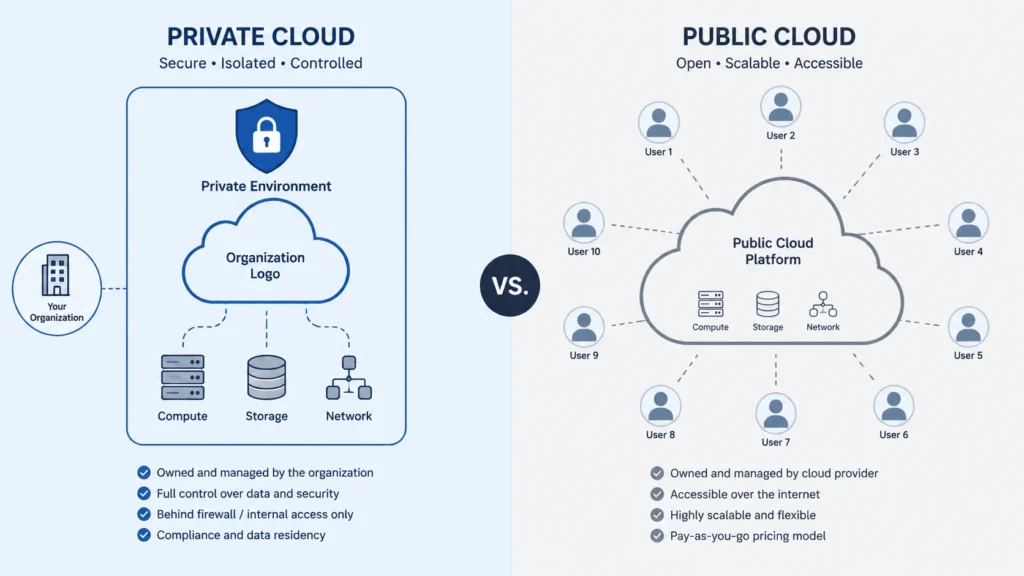
Public AI tools, think of the consumer chatbots and shared APIs most people interact with, are built for broad accessibility. Anyone can sign up, send a prompt, and get a response. The tradeoff is that your inputs pass through infrastructure owned and operated by the AI provider. Depending on the provider’s policies, that data may be logged, used for model improvement, or retained for a set period.
Private AI flips that arrangement. The infrastructure is either owned by the organization using the AI or leased in a way that guarantees exclusive, isolated access. Nobody outside the organization, not even the software vendor, can see the prompts, the outputs, or the underlying data unless specifically granted access.
The practical differences show up in three areas. Data residency determines exactly which servers, regions, and jurisdictions your information touches. Model behavior in a private setup can be fine-tuned on your own documents and terminology instead of relying on a one-size-fits-all public model. Compliance becomes far easier to prove because you control the entire chain of custody for the data, which matters under frameworks like HIPAA, GDPR, and GLBA.
Public AI is not inherently unsafe. For general research, drafting, or brainstorming with no sensitive inputs, it works fine for most people. Private AI becomes the better choice the moment sensitive data enters the conversation.
How Private AI Actually Works
There is no single blueprint for private AI. Most implementations combine a few core techniques depending on budget, technical maturity, and regulatory pressure.
On-Premises Deployment
This is the most literal form of private AI. The organization runs the AI model on its own physical servers, inside its own building or a data center it fully controls. Nothing leaves the building. On-premises setups offer the strongest guarantee of data isolation, but they also carry the highest upfront cost and require in-house expertise to maintain the hardware and the model itself.
Virtual Private Cloud Deployment
A Virtual Private Cloud, or VPC, gives an organization an isolated slice of a major cloud provider’s infrastructure, such as AWS, Google Cloud, or Azure. The AI model runs inside that dedicated environment rather than on shared public servers. This approach delivers most of the control of on-premises deployment without the burden of owning physical hardware, which is why many mid-size and large enterprises land here.
Federated Learning
Federated learning trains a model across multiple separate data sources, such as different hospital branches or regional offices, without ever moving the raw data to a central location. Only the learned patterns, not the underlying records, get shared and combined. This technique is especially useful when an organization needs a model that understands data spread across many locations but cannot legally consolidate that data in one place.
Encryption and Confidential Computing
Even inside a private environment, encryption plays a role in every serious private AI deployment. Data gets encrypted at rest and in transit as a baseline. More advanced setups add confidential computing, which processes data in an encrypted state even while the model is actively using it, and homomorphic encryption, which allows calculations to run on encrypted data without ever decrypting it. These techniques close the gap between “data is protected in storage” and “data is protected while the AI is actively working with it.”
Why Organizations Choose Private AI
The decision to go private almost always traces back to one of four pressures.
Regulatory compliance sits at the top of the list for healthcare, finance, insurance, and government. Rules like HIPAA and GDPR do not just recommend data control, they require it, with real financial penalties for violations.
Competitive protection matters just as much for businesses whose value depends on proprietary data. A company will not want its internal pricing models, product roadmaps, or customer analytics passing through a system where a competitor could theoretically benefit from that provider’s model improvements.
Accuracy on internal knowledge is another driver. A private model can be trained or fine-tuned directly on a company’s own documents, support tickets, and terminology, producing far more relevant answers than a generic public model that has never seen that information.
Control over uptime and access rounds out the list. Organizations running mission-critical AI workflows often want the ability to set their own service levels rather than depending entirely on a third party’s availability.
Common Private AI Use Cases
1: Healthcare
Hospitals and clinics use private AI for clinical decision support, medical imaging analysis, and administrative automation, all while keeping patient records inside systems that meet HIPAA requirements. A model that reviews scan results, for example, can run entirely within a hospital’s own network so patient data never reaches an outside server.
2: Finance
Banks and financial institutions apply private AI to fraud detection, document summarization, and customer communication analysis. Because financial data falls under strict rules like GLBA, keeping the AI model inside a private cloud rather than a public one is close to non-negotiable for regulated transactions.
3: Retail and Customer Service
Retailers use private AI to personalize recommendations and analyze customer behavior without exposing purchase histories or payment details to outside systems. This becomes increasingly important as retailers adopt AI-driven personalization at scale, since the same data that powers good recommendations is also the data customers care most about protecting.
Challenges and Trade-Offs of Private AI
Private AI is not free of downsides, and pretending otherwise does not help anyone making a real decision.
Cost is the most immediate barrier. On-premises hardware, specialized staff, and ongoing maintenance add up quickly, and even VPC deployments carry higher costs than shared public API access.
Technical complexity is the second obstacle. Running and fine-tuning a private model requires machine learning expertise that many smaller organizations simply do not have in-house, which often means hiring specialists or partnering with a vendor that manages the deployment.
Slower iteration is a less obvious trade-off. Public AI providers push frequent model updates and new features to everyone at once. Private deployments often lag behind because updates require testing and re-validation inside the organization’s own environment before going live.
Scale limitations can also appear. An organization without heavy, high-volume AI workloads may find that the fixed costs of private infrastructure outweigh the benefit compared to paying only for what it uses through a public API.
Is Private AI Only for Large Enterprises?
Not anymore. Private AI used to be realistic only for organizations with large IT budgets, but VPC-based deployments have brought the entry cost down considerably. Mid-size companies in regulated industries, such as regional healthcare providers, community banks, and law firms, now commonly use private AI without owning any physical servers of their own.

The right question is not company size but data sensitivity. A small business handling routine marketing copy has little reason to pay for private infrastructure. A five-person medical billing company handling patient claims has a strong reason to consider it, regardless of headcount.
How to Get Started With Private AI
Start by identifying exactly which workflows touch sensitive or regulated data. Not every AI use case in an organization needs a private deployment, and mixing private and public tools by use case is common and often the most cost-effective approach.

From there, choose a deployment model that matches technical capacity. Organizations without in-house machine learning teams typically start with a VPC deployment through a major cloud provider, since it offers strong isolation without requiring physical hardware management. Organizations with stricter regulatory requirements or existing data center infrastructure often move toward on-premises or hybrid setups instead.
Finally, involve compliance and security teams from the first planning meeting, not after the model is already built. Retrofitting privacy controls onto an existing AI deployment is far more expensive than designing them in from the start.