
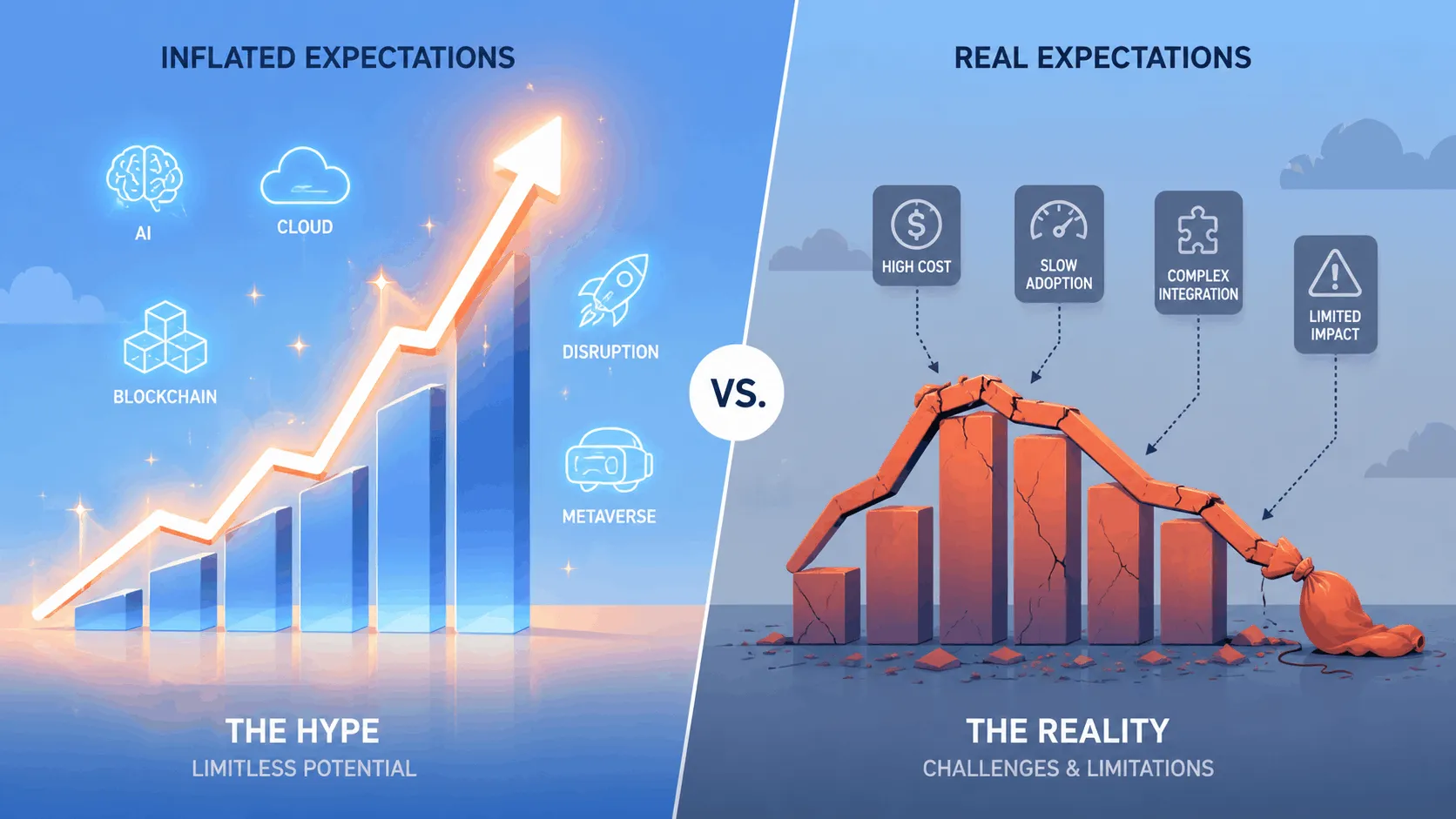
The honest answer is both yes and no, and the specific parts that are true depend entirely on which claim about AI you are evaluating. Some predictions about artificial intelligence have already come true faster than expected. Others were marketing exaggeration from the start and were never going to hold up. Treating “AI” as one single thing that is either hyped or not hyped is the first mistake most people make when they try to answer this question.
This article breaks the debate into its actual parts: what the hype claims, where the technology has delivered, where it has fallen short, and how to judge new AI claims for yourself instead of relying on headlines from either side.
What People Mean When They Say AI Is Overhyped
“AI is overhyped” usually bundles together three separate complaints, and most arguments about it fail because people are arguing past each other on different points.
The first complaint is about marketing language. Companies label ordinary automation and basic recommendation algorithms as “AI” to boost valuations and product pages, even when nothing resembling modern machine learning is involved. This is a real and well documented problem often called AI washing.
The second complaint is about timelines. Predictions that AI would replace most white collar jobs, drive cars everywhere without a human, or reach general intelligence within a specific year have repeatedly missed their targets. Missed timelines fuel a strong sense of hype fatigue.
The third complaint is about the technology itself, meaning whether large language models and related systems are fundamentally limited or whether they represent a genuine leap in capability. This is the hardest of the three to settle, because reasonable experts still disagree on it.
Separating these three threads matters because you can agree AI marketing is overhyped while still agreeing the underlying technology is genuinely useful.
The Strongest Case That AI Is Overhyped
1: Promises Outran the Shipped Product
Self driving cars were promised as a near term reality more than a decade ago, and full autonomy without any human oversight is still not standard on public roads. Several early “AI powered” consumer products, from chatbots to smart assistants, were quietly walked back or shut down after failing to deliver on launch promises. When a pattern of missed predictions repeats across multiple companies and years, skepticism becomes a reasonable default.
2: Productivity Gains Are Uneven, Not Universal
Enterprise adoption of generative AI is high, yet the return on that investment has been inconsistent across industries. Some teams see meaningful output gains in coding, drafting, and research summarization. Other deployments produce marginal or unclear results, particularly where the task requires precise accuracy or heavily regulated judgment calls. A tool that helps one team draft emails faster is not the same thing as a tool that reliably transforms an entire company’s output, and vendor case studies rarely make that distinction clear.
3: Investment Levels Have Outpaced Proven Business Models
Billions of dollars have flowed into AI infrastructure, chips, and startups on the assumption that revenue will eventually catch up to spending. Analysts who study technology cycles have pointed out that this pattern, heavy capital investment ahead of proven monetization, resembles earlier speculative bubbles in other industries. That does not mean the technology is worthless, but it does mean current valuations may not survive a correction.

The Strongest Case That AI Is Not Overhyped
1: Capability Gains Have Been Real and Fast
Language models went from producing broken, unreliable text a few years ago to passing professional exams, writing functional software, and holding coherent conversations across long sessions. Image generation moved from obviously artificial output to results that require close inspection to identify as synthetic. This pace of improvement, compressed into a short number of years, is unusual even by the standards of fast moving technology sectors.
2: Adoption Has Already Changed Daily Workflows
Coders now routinely use AI assistance to write and debug code faster. Customer support teams use AI to draft and triage responses. Researchers use it to summarize dense material in minutes instead of hours. These are not speculative future use cases, they are already happening at scale, and removing the tools now would visibly slow down the people who depend on them.
3: The Skeptical Case Sometimes Understates Risk
Ironically, some of the loudest “overhyped” arguments focus on consumer chatbot gimmicks while overlooking where AI is quietly reshaping higher stakes areas. Automated systems already influence hiring screens, fraud detection, medical imaging review, and cybersecurity threat response. Whether or not the term AI is overhyped in marketing copy, the underlying systems are already making decisions that affect real people, which is a different and arguably more serious concern than whether a chatbot is impressive.
Why the Hype Cycle Explains Both Arguments at Once
Technology researchers have long used a hype cycle model to describe how new technologies are received. A new capability generates excitement that quickly overshoots realistic near term expectations, then interest crashes into a period of disillusionment once people notice the gap between promise and delivery. Only after that correction does adoption settle into a slower, more accurate picture of what the technology can actually do.
Generative AI shows clear signs of moving through exactly this pattern. Early claims that it would replace entire job categories within a year or two did not hold up, and that disappointment has driven a wave of “AI is overhyped” commentary. At the same time, the underlying capability curve has not slowed down, it has kept climbing steadily in the background while public sentiment cycled from excitement to skepticism.
This explains why you can find credible experts confidently arguing both sides. They are often looking at different parts of the same curve, one looking at inflated near term claims, the other looking at the underlying technical trend line.
A Practical Framework for Judging Any AI Claim
Instead of asking whether AI in general is overhyped, apply these questions to a specific claim.
Ask whether the claim is about a capability that exists today or a capability promised for some future date. Existing capabilities can be tested directly. Future promises cannot, and should be weighted accordingly.
Ask who benefits from you believing the claim. A vendor selling AI software has a financial incentive to overstate its reliability, while a competitor or a skeptic may have an incentive to understate it.
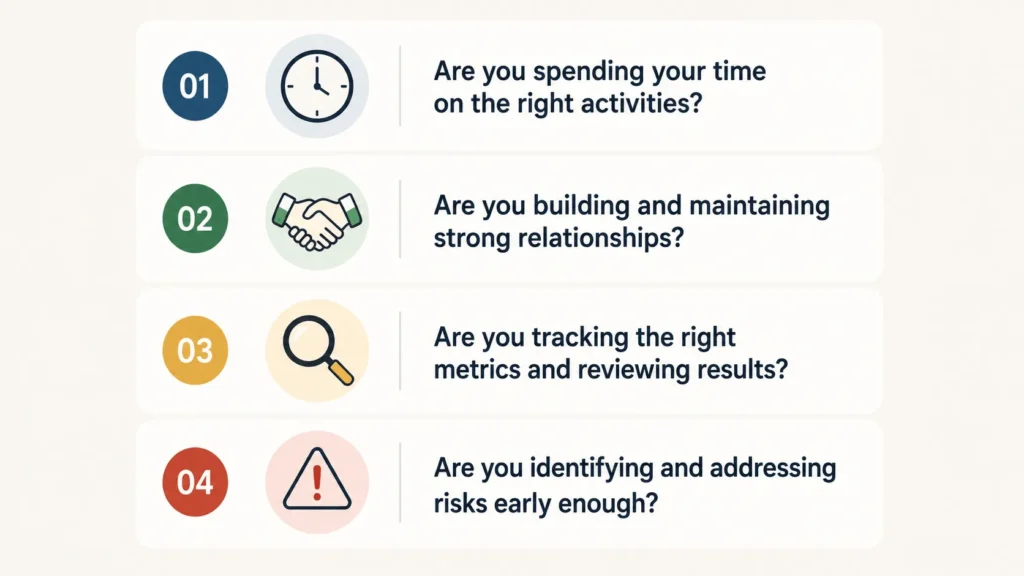
Ask whether the claim has been independently reproduced outside the company that built the product, since internal benchmarks are far easier to optimize than real world, third party testing.
Ask what happens when the system is wrong, because a chatbot giving a wrong trivia answer carries very different stakes than an automated system making an error in a medical, financial, or legal context.
Where AI Tends to Be Overhyped vs Where It Tends to Be Underhyped
Certain categories consistently attract inflated claims. General artificial intelligence, meaning a system with human level reasoning across every domain, remains far off despite frequent predictions that it is imminent. Fully autonomous vehicles operating without any human backup in all conditions are also consistently overpromised relative to actual deployment. Claims that AI will fully replace entire professions rather than reshape parts of them tend to age poorly as well.
Other categories are arguably underdiscussed relative to their real impact. AI generated misinformation and deepfakes have advanced quietly and now pose a genuine challenge for verifying what is real online. AI driven cyberattacks have become faster and more adaptive, with automated reconnaissance now compressing what used to take weeks into hours. Narrow, well scoped applications like code completion, translation, and medical image screening have quietly become reliable tools without generating nearly as many headlines as flashier consumer products.
What This Means for Individuals Evaluating AI Tools
Treat every specific AI product claim on its own merits rather than importing a blanket opinion about whether AI as a category is overhyped. A tool can be genuinely useful for drafting and summarizing while still being unreliable for tasks requiring precise factual accuracy. Test any new AI tool on a task you already know the correct answer to before trusting it on something you do not, since this quickly reveals its real accuracy on your specific use case rather than its marketed accuracy.

Watch the gap between demo conditions and real world conditions, because product demos are built to showcase best case performance, and real world results are frequently messier. Finally, separate the underlying technical trend from the marketing layer sitting on top of it, since the technology can keep improving steadily even while individual products or predictions built around it turn out to be overstated.