
Ask ten people whether AI is a bubble and you’ll get ten different answers, often from the same person twice. Sam Altman has said he believes investors are overexcited about AI. Jeff Bezos has called it an “industrial bubble” while still pouring billions into it. Jensen Huang insists the opposite is true. When the people building the technology can’t agree on whether it’s overvalued, the honest answer is that nobody knows for certain yet. What we can do is look at the actual mechanics of how bubbles form, check AI spending against those patterns, and see where the evidence points.
This guide breaks down what a bubble actually is, the strongest arguments on both sides, how the current moment compares to the dot-com crash, and what a burst would mean for your money if it happens.
What Actually Makes Something a Bubble
A bubble isn’t just a big price increase. Prices rise all the time for good reasons, like a company growing its revenue or a technology proving itself out. A bubble happens when prices detach from what an asset can realistically earn in the future, and people keep buying anyway because prices are rising, not because the underlying business justifies the price.
The tricky part is that you can’t always tell the difference between a bubble and a real boom while it’s happening. Amazon’s stock cratered by over 90 percent when the dot-com bubble burst in 2000, yet Amazon itself went on to become one of the most valuable companies in history. The technology was real. The prices, for a while, were not connected to it.
That distinction matters here. AI as a technology is not in question. Whether the current valuations, spending levels, and business models attached to it are sustainable is a separate question entirely.
The Case That AI Is a Bubble
1: A Handful of Stocks Are Carrying the Market
A small group of companies, often called the Magnificent Seven, now makes up a record share of the S&P 500’s total value. When that much of the market’s gains depend on so few names, any stumble in AI sentiment can drag the entire index down with it, even for people who never bought an AI stock directly through their retirement accounts.
2: Circular Deals Are Inflating Demand
One of the more specific warning signs involves a web of interlocking agreements between the major AI players. Nvidia invests in companies that then use that money to buy Nvidia chips. Cloud providers sign multibillion dollar deals with AI labs that, in turn, spend that money back on cloud capacity from those same providers. Money moves in a circle, and each leg of that circle gets counted as fresh revenue or fresh demand, which can make the market look stronger than it is if you strip the circularity away.
3:Productivity Gains Haven’t Caught Up Yet
A widely discussed MIT study found that a large majority of organizations investing in generative AI pilots weren’t seeing a measurable financial return. Corporate profit margins for S&P 500 companies overall have barely moved since AI spending accelerated, even as the stocks of AI-linked companies have soared. If AI were already transforming corporate profitability at the pace its valuations imply, that gap should be closing faster than it is.
The Case That AI Is Not a Bubble
1:The Revenue Is Real, Not Speculative
Unlike many dot-com companies that had no revenue at all, the biggest AI players report real, substantial, and growing sales. Cloud computing divisions at the major hyperscalers post billions in AI-related revenue every quarter, and demand for AI infrastructure is backed by actual signed contracts, not just investor hope.
2: The Core Companies Can Afford the Bet
Microsoft, Google, Amazon, and Meta are funding much of their AI buildout from enormous existing cash flows, not from debt they can’t service. That’s a meaningfully different financial position than dot-com era startups that burned through venture funding with no path to profitability. A company that can absorb a bad quarter is in a different category of risk than one that can’t survive one.
3: Even Skeptics Admit the Technology Works
Almost none of the people warning about a bubble are arguing that AI itself is fake or useless. Jensen Huang has pointed to strong underlying demand for computing power as evidence the current buildout reflects real usage, not hype alone. The debate is about price, not about whether the technology has value.
How This Compares to the Dot-Com Bubble
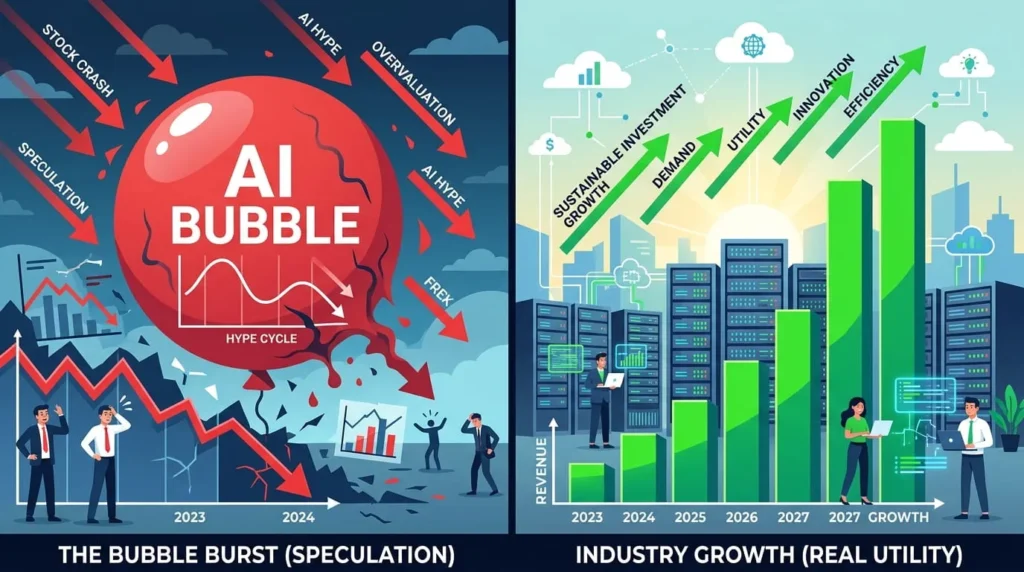
The comparisons to 2000 are everywhere, and some of them hold up. Both periods feature a transformative technology, a flood of capital, and stock prices that ran well ahead of near-term earnings. Both saw a small group of hyped companies dominate market gains while ordinary manufacturing and job growth sat well behind stock performance.
But the differences matter too. Dot-com era companies routinely went public with no revenue and no plan to generate any within a reasonable timeframe. Today’s leading AI companies are, for the most part, already large, profitable businesses layering AI onto existing revenue streams. That doesn’t mean a correction is impossible. It means a burst, if it happens, would likely look different: a sharp repricing of overextended valuations rather than a wholesale collapse of companies with nothing behind them.
What Happens If the AI Bubble Bursts
If AI valuations do correct sharply, the effects wouldn’t stay contained to tech stocks. Because AI companies now represent such a large share of major stock indexes, a steep drop would hit retirement accounts, pension funds, and index funds broadly, even for people who never chose to invest in AI specifically.

Beyond the market, a pullback in AI spending could slow construction tied to data centers, an industry that has been propping up parts of the broader building sector. Companies that took on debt to fund data center expansion would face pressure if AI revenue growth slowed at the same time. None of this means a recession is guaranteed. It means the AI sector has become large enough that its problems would ripple outward rather than stay isolated.
How to Protect Yourself If You’re Worried About an AI Bubble
You don’t need to predict the exact moment a bubble bursts, if one exists, to manage the risk sensibly.
Check how concentrated your portfolio actually is. If most of your retirement account sits in a total market index fund, you may have more AI exposure than you realize, since a handful of AI-heavy stocks now make up a large slice of that index.
Resist chasing recent performance. Buying into AI stocks purely because they’ve already run up sharply is exactly the behavior that inflates bubbles further, whether or not this one eventually pops.
Rebalance on a schedule rather than a hunch. Trimming winners back to your target allocation periodically protects you from overexposure without requiring you to correctly time a market top.
Keep a long time horizon for money you can’t afford to lose in the short term. Even genuine technological revolutions come with volatile stock prices along the way, and selling in a panic during a downturn locks in losses that a longer holding period might have recovered.
So, Is AI a Bubble?
The honest answer is that AI shows real signs of both a genuine technological shift and a market that has gotten ahead of itself in places. The technology is not the problem. Some of the financing behind it, the concentration of stock market gains in a few companies, and the gap between spending and measurable returns are the parts worth watching closely.

You don’t have to resolve the debate to act sensibly. Understand how much of your own financial life is exposed to a handful of AI-driven stocks, keep your allocation deliberate rather than accidental, and treat confident predictions about exactly when or whether a bubble will burst with healthy skepticism, no matter who is making them.